AI Content & SEO
How to Fact Check AI Generated Content: A Step-by-Step Checklist for Publishers
Fact-checked: 8 claims checked against sources

Fact-checking AI-generated content requires extracting every specific claim and verifying it against primary sources, because AI models predict word sequences rather than retrieving verified facts. This guide provides a practical checklist to verify names, numbers, dates, and quotes, handle unconfirmed claims, and maintain source links in your WordPress or Ghost articles.
Why AI Hallucinates and Gets Facts Wrong
AI text generators produce errors because they calculate the most probable sequence of words to answer a prompt, rather than assessing whether the information is actually correct. They generate what they believe is the most likely string of words based on training data, making manual verification essential for publishers who need accurate, reliable content for their readers.
A recent study by the BBC and the European Broadcasting Union found that around 45% of AI news queries produce errors across major platforms like ChatGPT, MS Copilot, Gemini, and Perplexity. The systems often pull from faulty, exaggerated, or outdated data. On 1 October 2026, Google updated its guidance to state that generative models do not retrieve facts, making it "critical to manually fact check and review all AI-generated content" before publishing. This review must also cover metadata like meta descriptions and image alt text.
How to Extract and Verify Every Claim in Your Draft
Write & Grow Blog
You must isolate every name, statistic, date, and quote in your AI-generated draft and trace each one back to a primary source to ensure accuracy. Relying on the AI's own citations is risky, as the model can invent plausible-sounding URLs and author names, requiring you to perform independent lateral reading to confirm the facts.
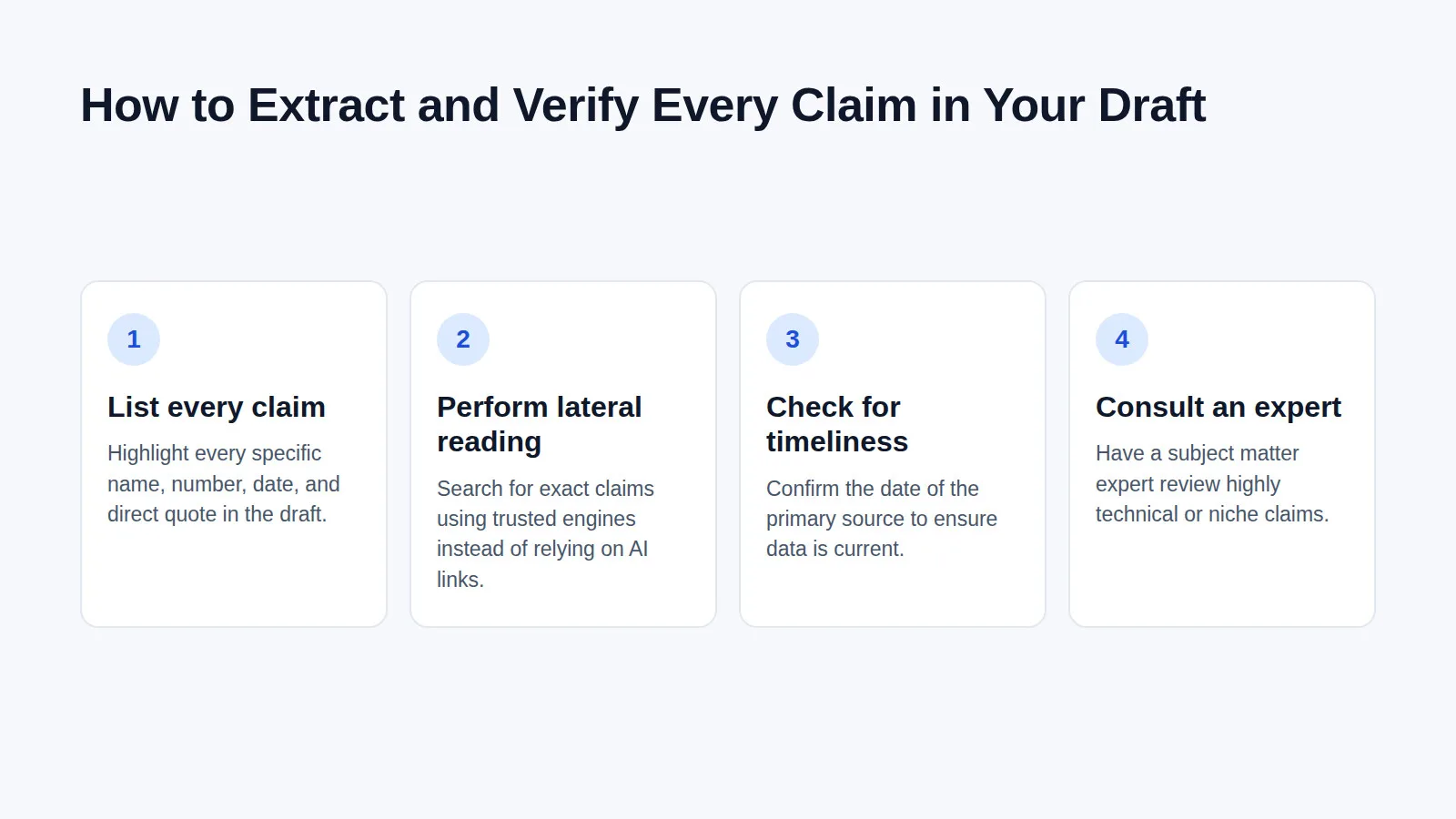
Follow this step-by-step verification protocol for your articles:
- List every claim: Read through the draft and highlight every specific name, number, date, and direct quote.
- Perform lateral reading: Open a new browser tab and search for the exact claim using trusted search engines, rather than just reading the links the AI provided.
- Check for timeliness: Verify that the data is current. AI often pulls outdated information, so confirm the date of the primary source.
- Consult an expert: For highly technical or niche topics, have a subject matter expert review the specific claims.
The Canadian Marketing Association recommends a rapid 5-10 minute assessment for routine content to catch repetitive phrasing, unsourced statistics, and contradictory information before moving to comprehensive validation.
What to Do With Claims You Cannot Confirm
Write & Grow Blog
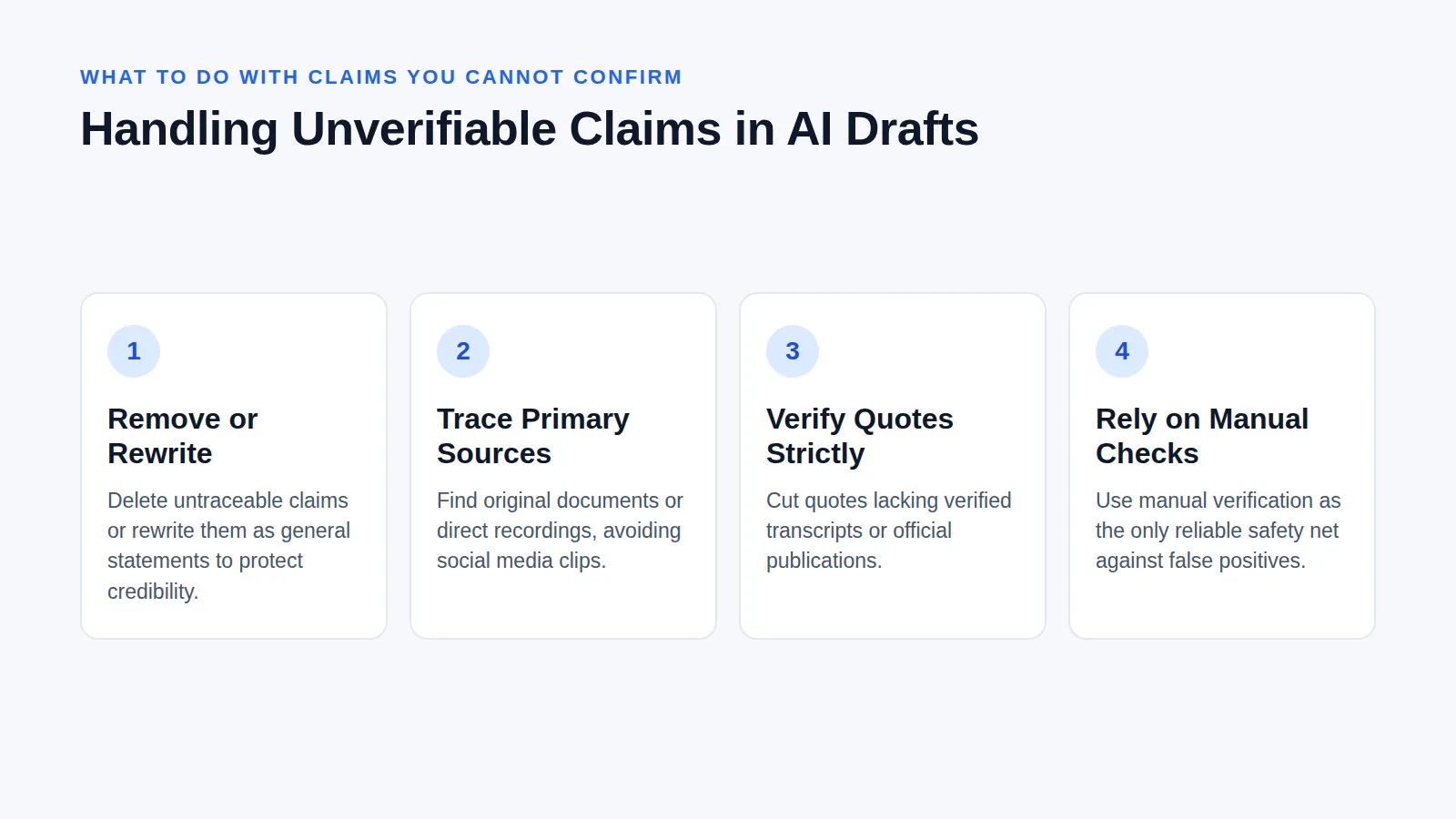
Any claim that cannot be traced to a verifiable primary source must be removed from your draft or rewritten as a general statement, as publishing unverified AI output damages your site's credibility. If you cannot find a primary source for a specific statistic, the safest action is to delete it entirely to protect your brand reputation and search rankings.
When verifying authorship or quotes, trace the information back to sources in a position to know the truth, such as an original document shared by an archive or a direct recording of a statement. Do not rely on social media clips or secondary summaries. If an AI generates a quote attributed to a historical figure or a modern executive, and you cannot find it in a verified transcript or official publication, cut it. Remember that both human readers and AI detectors have false positives, so your manual verification process is the only reliable safety net.
Common AI Errors to Watch Out For
Write & Grow Blog
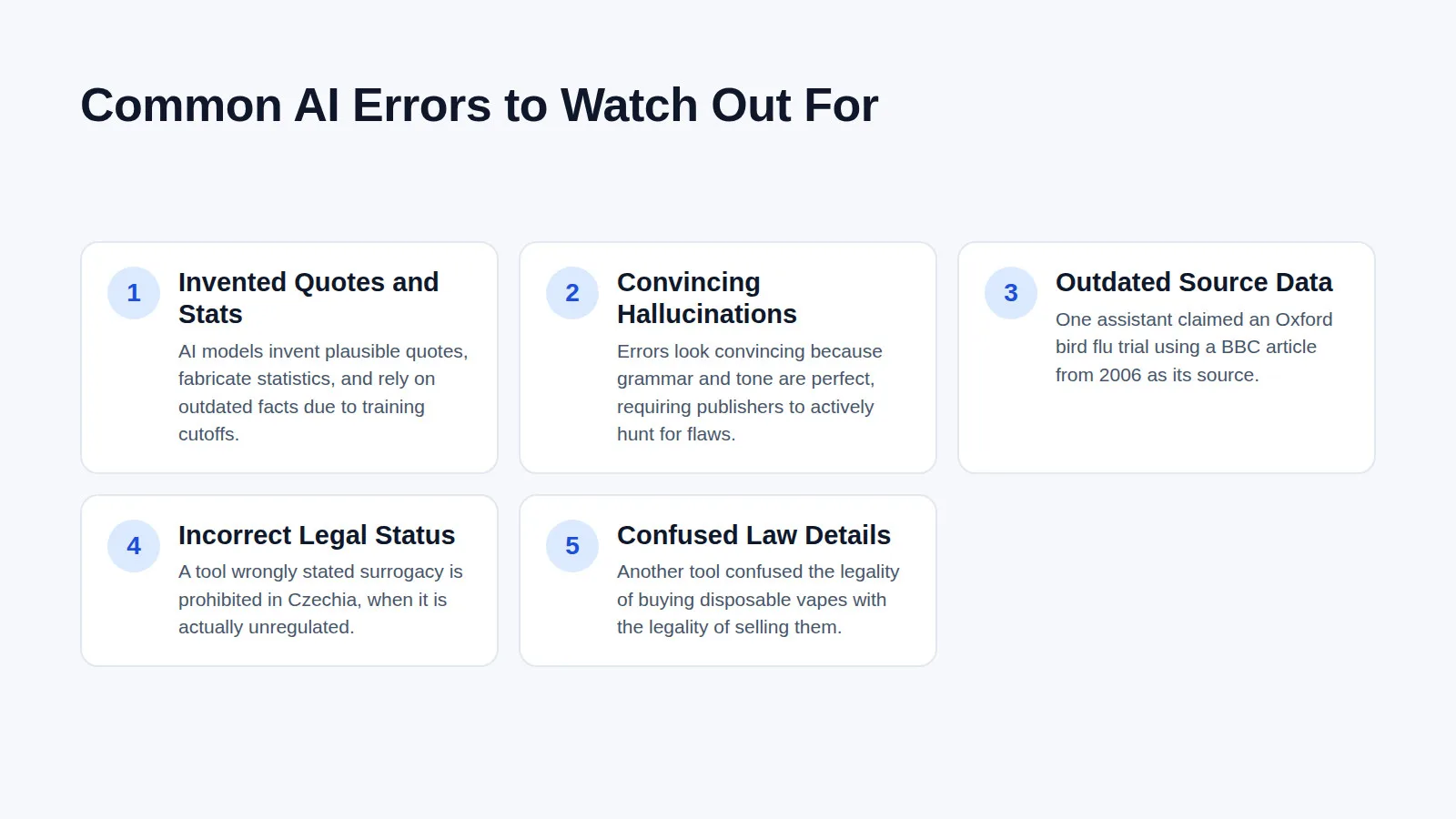
AI models frequently invent plausible-sounding quotes, fabricate statistics, and rely on outdated facts because their training data has a strict cutoff date and lacks real-world context. These errors, often called hallucinations, look incredibly convincing because the grammar and tone are usually perfect, which means publishers must actively hunt for these specific flaws in every draft.
Consider the specific errors highlighted in the BBC and EBU study. When asked about a bird flu vaccine trial, one AI assistant claimed a trial was underway in Oxford, but the source it relied on was a BBC article from 2006. In legal contexts, one tool incorrectly claimed that surrogacy is prohibited by law in Czechia, when it is actually unregulated. Another tool incorrectly characterized a law change regarding disposable vapes, confusing the legality of buying them with the legality of selling them. These examples show that AI can confidently state the opposite of the truth.
"The AI isn't assessing whether the information it provides is 'correct' in the same way a human would." — University of Maryland Libraries
How to Keep Sources Linked in Your WordPress or Ghost Text
You should hyperlink the specific factual claim directly to the primary source URL within your text, rather than just listing references at the bottom of the page, to build trust with readers and search engines. Embedding the link directly into the relevant phrase improves the user experience and provides clear attribution for the facts you are presenting.
For example, instead of writing Studies show AI makes errors and putting a link in a bibliography, write Studies show AI makes errors in 45% of news queries. Ensure the link text is descriptive and tells the reader exactly what they will find. Avoid stacking multiple links on the same phrase, and never link the same URL more than once in a single article. Use tools like the Factcheck.org non-profit database or the Associated Press Fact Check to find authoritative URLs to link to when verifying your own claims.
What This Means for WordPress Site Owners and Agencies
Implementing a strict fact-checking routine protects your WordPress site from Google's scaled content abuse policies while maintaining the topical authority required for strong search rankings. When you use AI to speed up your content planning or autoblogging workflows, the time saved on drafting must be reinvested into manual verification to ensure your articles remain accurate and trustworthy.
If you publish unverified AI content, you risk triggering manual actions or losing rankings due to a lack of experience, expertise, authoritativeness, and trustworthiness (E-E-A-T). At Write & Grow, we often see agencies automate their RSS-to-post workflows, but the bottleneck always shifts from writing to editing and fact-checking. Building a standardized checklist into your editorial calendar ensures that your hub and pillar pages remain accurate, your internal linking points to verified claims, and your Core Web Vitals aren't negatively impacted by bloated, unedited AI drafts.
Before you hit publish on any AI-assisted article, run it through this quick-reference summary:
- Extract: Highlight every name, number, date, and quote.
- Verify: Search each claim in a new tab using primary sources.
- Update: Replace any outdated facts with current data.
- Delete: Remove any claim you cannot independently verify.
- Link: Hyperlink the verified claim directly to the primary source URL.
Frequently asked questions
How to fact check AI generated content?
Fact-checking AI-generated content involves extracting every specific claim, such as names, statistics, and quotes, and verifying each one against a primary source using lateral reading. You must check the timeliness of the data and remove any claim that cannot be independently confirmed by a trusted authority or official document.
How to check if content is created by AI?
Checking if content is created by AI involves looking for unnatural language patterns, repetitive phrasing, generic language, and unsourced statistics. However, because both human readers and computerized AI detectors produce false positives, the most reliable method is to verify the underlying facts and trace the authorship directly with the creator.
How can bias appear in AI generated content?
Bias appears in AI-generated content because the models are trained on massive datasets that reflect the historical, cultural, and societal biases present in their training data. The AI predicts the most probable words based on these patterns, which can inadvertently amplify stereotypes or present a skewed perspective on complex topics.