AI Content & SEO
Is AI Content Bad for SEO? What Google Actually Says
Fact-checked: 12 claims checked against sources Reviewed by Shahid Anwer

Google ranks content based on its helpfulness and quality, not on whether a human or a machine wrote it. However, using AI to mass-produce unhelpful content specifically to manipulate search rankings violates Google's spam policies. This guide explains Google's exact rules on AI content, how E-E-A-T applies to automated workflows, and how to safely publish AI-assisted articles on your WordPress site.
Does Google penalize AI-generated content?
Google does not penalize content simply because it is AI-generated. The search engine evaluates the finished page based on its quality and helpfulness to users, meaning the production method itself is not a ranking factor or a cause for manual action.
Before the current generative AI boom, Google already addressed "automatically generated content." The core principle has remained consistent for years. As the Google Search Quality team stated in their official guidance on AI-generated content:
"Our focus on the quality of content, rather than how content is produced, is a useful guide that has helped us deliver reliable, high quality results to users for years."
Automation has long been used to publish helpful information, such as weather forecasts, sports scores, and financial tickers. AI is simply a new tool that can power new levels of expression. The violation occurs only when automation is used with the primary purpose of manipulating search rankings. If your AI-assisted article is written to help a reader solve a problem, it complies with Google's guidelines.
What makes AI content rank or fail in search?
Write & Grow Blog
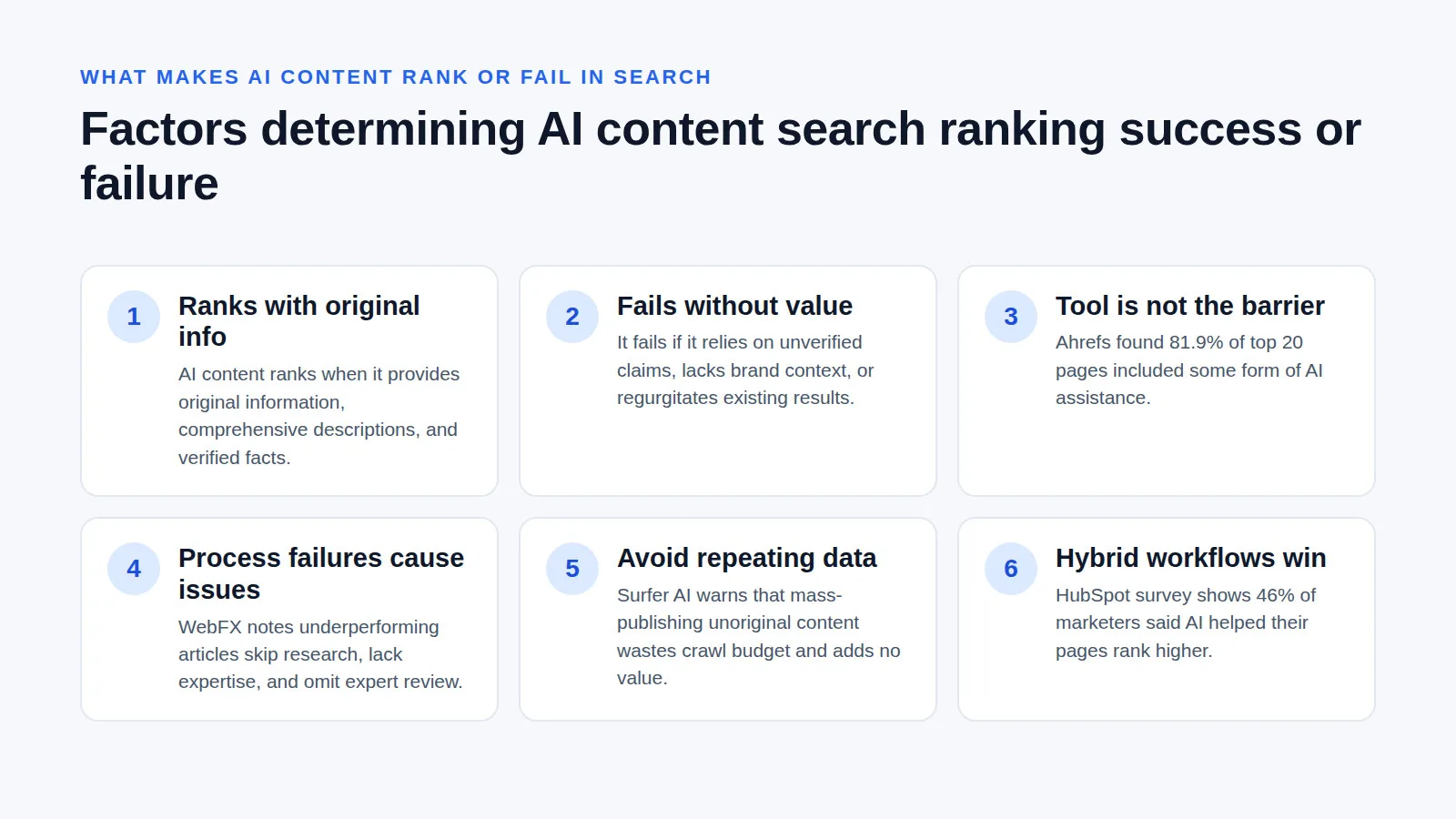
AI content ranks when it provides original information, comprehensive descriptions, and verified facts that actively help users. It fails when it relies on unverified claims, lacks brand context, or simply regurgitates existing search results without adding any independent value.
Many site owners worry that AI content is inherently disadvantaged in search results. However, an analysis of 100,000 random keywords by Ahrefs found that 81.9% of the top 20 ranking pages included some form of AI assistance. The tool itself is not the barrier to ranking.
When AI content fails, it is usually due to process failures rather than the technology itself. According to WebFX, underperforming AI articles typically skip critical steps: they lack research into what currently ranks, contain no original data or first-hand expertise, include unverified statistics, and go through no expert review before publishing.
Because large language models are trained on preexisting data, there is always a risk that the output simply repeats what is already published. As noted in Surfer AI's analysis, publishing unoriginal content at a massive scale creates a lose-lose situation: it provides no new value to the user and wastes Google's crawl budget. To prevent this, you must ensure your AI drafts introduce new angles, original data, or unique synthesis that the model could not have generated on its own.
Conversely, when creators use AI to accelerate research, build detailed outlines, and draft initial sections—then layer in proprietary data and human editing—the resulting content competes effectively. A HubSpot survey of marketers found that 46% of respondents said AI helped their pages rank higher, proving that AI-assisted workflows can yield positive SEO outcomes when managed correctly.
How does E-E-A-T apply to AI-assisted articles?
Write & Grow Blog
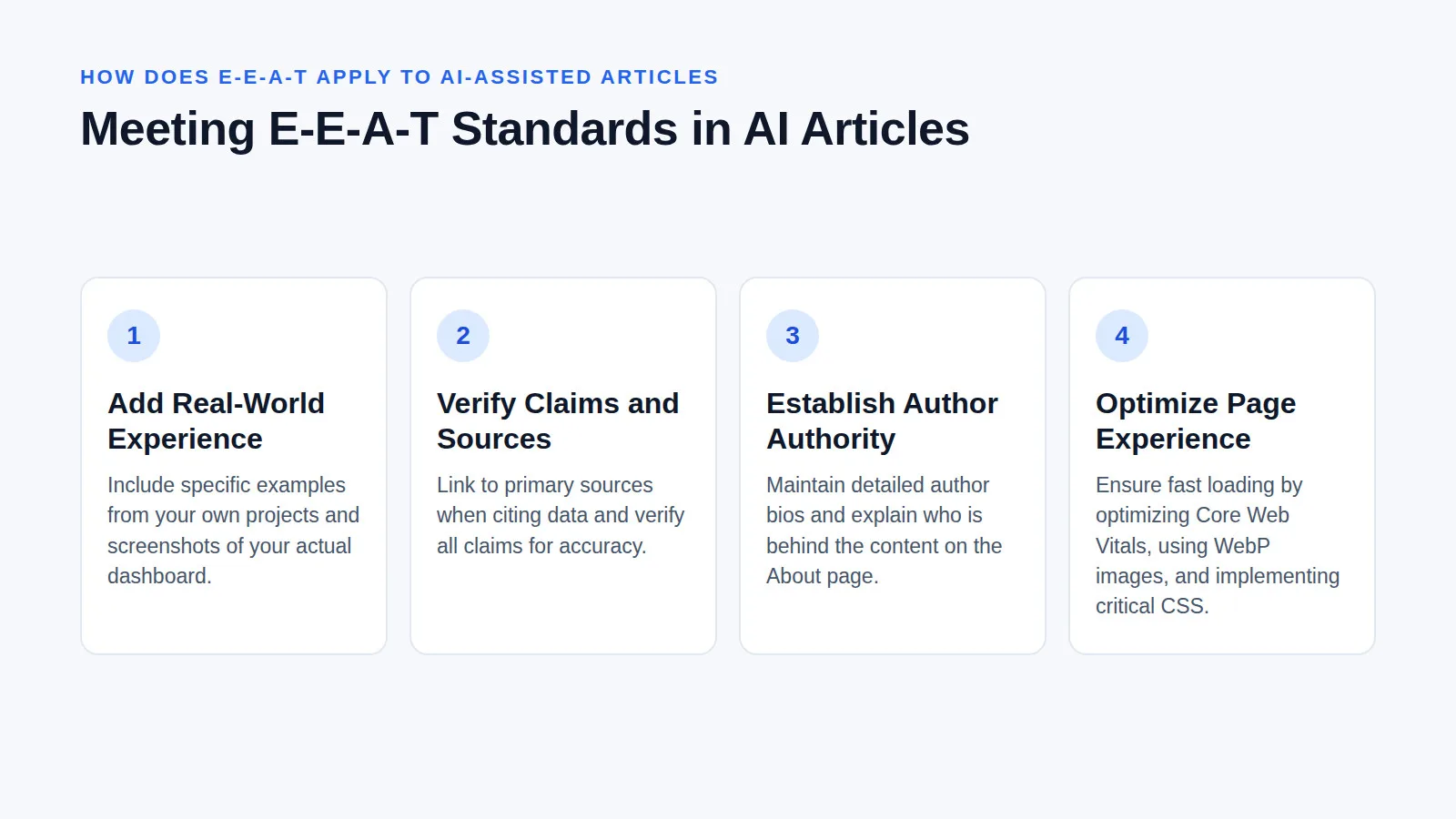
E-E-A-T (Experience, Expertise, Authoritativeness, and Trustworthiness) requires first-hand knowledge and verified accuracy, which AI models cannot generate independently. To satisfy these E-E-A-T standards, human creators must inject real-world experience, verify all claims, and establish clear author authority on the page.
Google expanded its E-A-T framework to include "Experience" in December 2022 to emphasize the value of first-hand usage. An AI language model has never installed a WordPress plugin, tested a specific theme, or managed a content calendar. It can only synthesize existing text.
To meet E-E-A-T requirements when publishing on WordPress or Ghost, you must supply the experience the AI lacks. Include specific examples from your own projects, share screenshots of your actual dashboard, and reference unique challenges you have solved.
Furthermore, Google's helpful content guidelines recommend clear sourcing and evidence of expertise. Always link to primary sources when citing data, maintain detailed author bios, and ensure your site's About page clearly explains who is behind the content. AI can structure the arguments, but your personal expertise must validate them.
Beyond the text itself, Google's core ranking systems look to reward content that provides a good page experience. Site owners must not focus solely on the words generated by AI. Core Web Vitals are part of how Google assesses page experience, so it pays to keep your WordPress site fast: a lightweight theme, compressed images (WebP is a good choice) and critical CSS all help. A technically sound, fast-loading page gives your high-quality AI-assisted content the best chance to rank.
What is scaled content abuse and how do you avoid it?
Write & Grow Blog
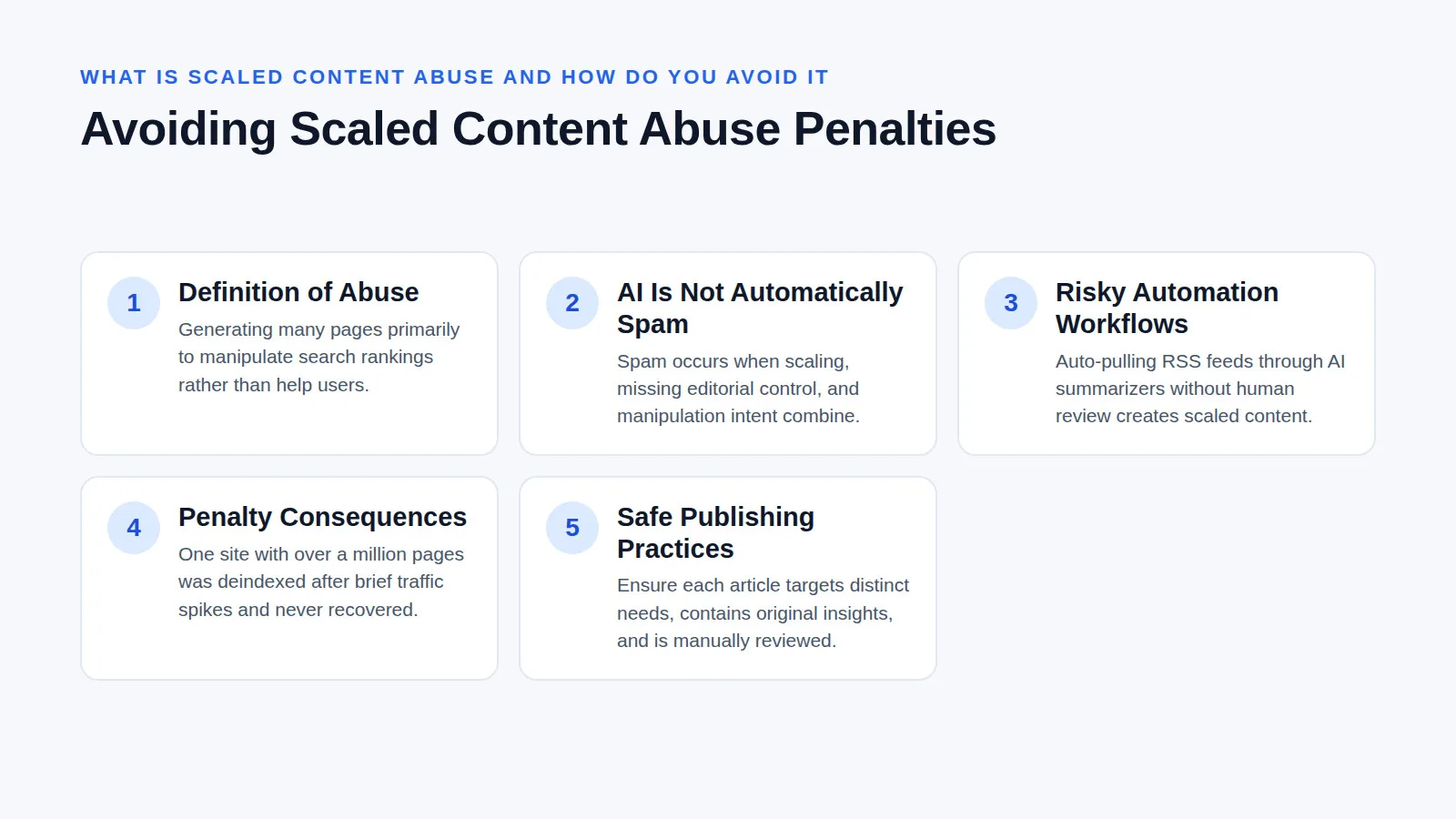
Scaled content abuse occurs when many pages are generated primarily to manipulate search rankings rather than help users. This strict policy applies regardless of whether the content is written by humans, generated by AI, or stitched together from scraped feeds.
In “March 2024, Google introduced scaled content abuse” into its spam policies. The policy defines this abuse clearly: "Scaled content abuse is when many pages are generated for the primary purpose of manipulating search rankings and not helping users." Google's own examples list generative AI tools alongside scraping feeds and spinning synonyms.
The Grounding Page project clarifies that "AI Content Spam does not mean that AI-generated content is automatically spam." Instead, it happens when scaling, missing editorial control, and a primary intent to manipulate come together. This is highly relevant for site owners using autoblogging or RSS-to-post workflows. If you configure a plugin to automatically pull RSS feeds, run them through an AI summarizer, and publish hundreds of posts a day without human review, you are creating scaled content.
The dangers of ignoring this policy are well-documented. In April 2026, SEO consultant Glenn Gabe documented what happened to National Today, which had more than 850,000 AI-generated local news articles indexed in one section of its site. Google applied a manual action for scaled content abuse, and that section's visibility collapsed in Search, AI Overviews and AI Mode, and its citations in ChatGPT answers largely disappeared too. Scaled content can bring short-term traffic, but it puts the site's long-term search visibility at risk.
To avoid this penalty, never use automation to bypass the editorial process. Every page you publish must offer substantial, independent value. If you are producing content at a high volume, ensure each article targets a distinct user need, contains original insights, and has been manually reviewed for accuracy and quality.
How to build a safe AI content workflow for WordPress
A safe AI workflow treats the language model as a drafting assistant rather than an autopilot publisher. By combining strategic research, strict fact-checking, and proper WordPress formatting, you can scale your content production without triggering spam filters or losing reader trust.
Building a compliant workflow requires treating AI as one step in a larger editorial process. Follow these steps to ensure your AI-assisted content remains helpful and search-friendly:
- Research the current results: Before generating anything, analyze the top-ranking pages for your target keyword. Identify the questions they answer and the gaps they leave open.
- Build a strategic outline: Feed the AI model your unique angle, target audience details, and brand voice guidelines. Ask it to structure an outline that fills the gaps you identified.
- Draft and inject experience: Let the AI write the first pass based on your outline. Then, rewrite key sections to include your own first-hand experience, proprietary data, or specific anecdotes.
- Verify every factual claim: AI models hallucinate. Check every statistic, date, quote, and technical claim against a primary source. Remove any unverified assertions.
- Format and optimize: Use your CMS to add proper heading tags, optimize images for Core Web Vitals, and set up internal links to your hub and pillar pages.
- Schedule and publish: If you manage multiple sites or need to schedule these verified drafts, a tool like Write & Grow can help format and publish directly in WordPress, keeping your workflow organized without bypassing the crucial editorial step.
To clarify where the line is drawn, here is a breakdown of tasks suited for AI versus those that require human judgment:
| Task Category | Best Handled By | Why It Matters for SEO |
|---|---|---|
| Keyword Clustering | AI | Quickly groups related search intents to build comprehensive pillar pages. |
| First Draft Generation | AI | Speeds up the writing process, overcoming blank-page syndrome. |
| Fact-Checking | Human | AI hallucinates data; humans must verify claims against primary sources. |
| Adding First-Hand Experience | Human | AI lacks real-world usage; humans provide the "Experience" in E-E-A-T. |
| Internal Linking Strategy | Human | Requires understanding of site architecture and user navigation paths. |
| Brand Voice Nuance | Human | AI struggles with subtle tone; humans ensure content matches brand identity. |
Frequently asked questions
Does AI content harm SEO?
AI content only harms SEO if it is low-quality, unhelpful, or produced at scale specifically to manipulate rankings. High-quality, people-first content that happens to be AI-assisted will not harm your search visibility and can actually improve your publishing consistency.
Is AI content good for SEO?
AI content is good for SEO when it accelerates the creation of helpful, well-researched articles that fully satisfy user intent. It is highly effective for generating outlines, brainstorming angles, and speeding up the initial drafting process for human editors.
Can Google tell if I use AI to write my articles?
Google says its focus is on "the quality of content, rather than how content is produced" (Google Search Central, February 2023). However, if your AI content exhibits patterns of scaled content abuse or lacks original value, their quality systems will demote it.
Reviewed by Shahid Anwer